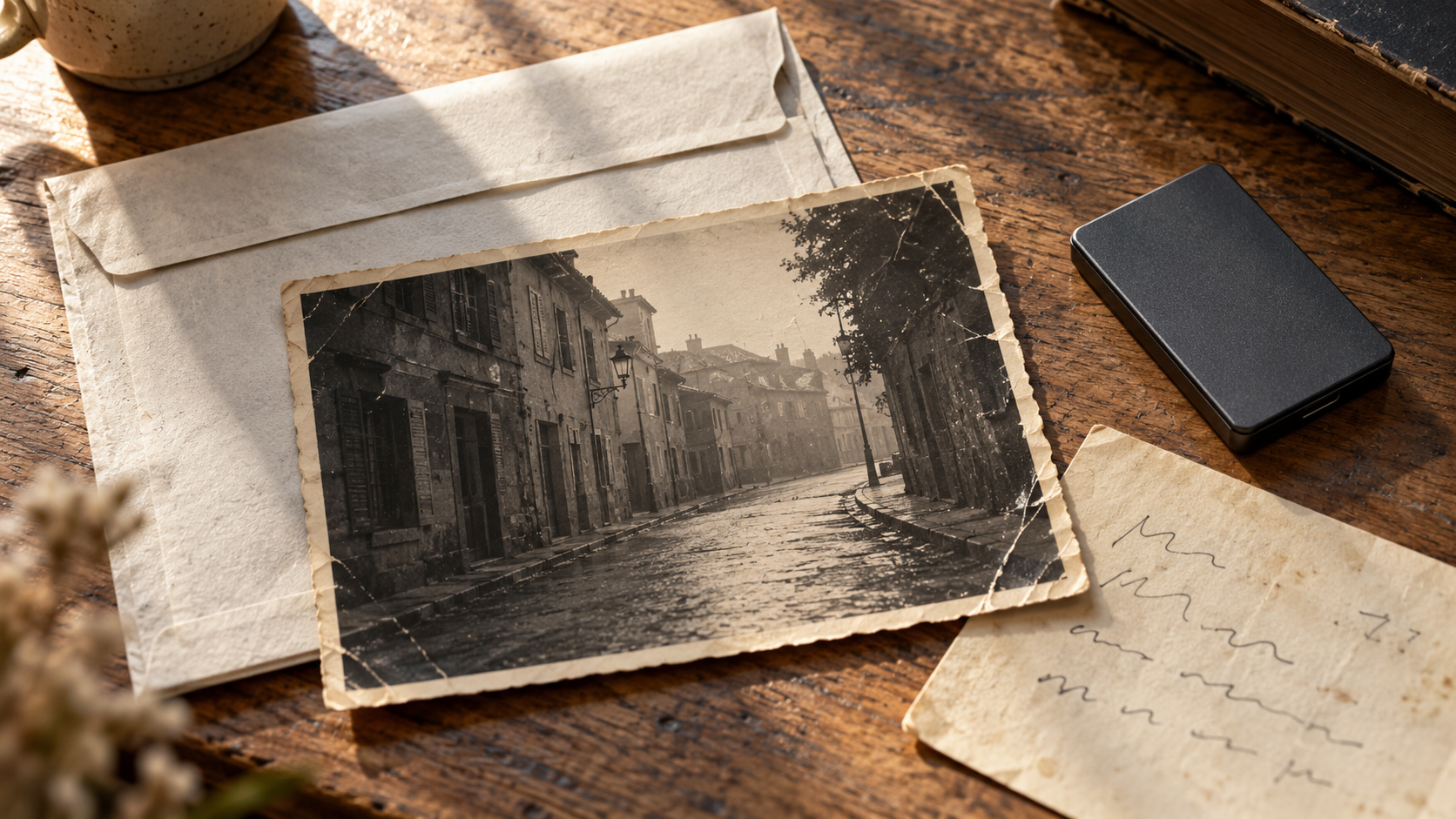
A photograph arrives in a folder named final-final-2. Its checksum matches the number recorded ten years earlier. That is excellent news about the bytes. It tells us much less about the wedding, workshop, or demolished street visible in the image. If nobody recorded who made it or what the filename replaced, perfect integrity can preserve an unanswered question with extraordinary precision.
Digital preservation begins with a wonderfully exact tool: compare what is here with what was recorded before. It cannot end there. The photograph has technical properties, a history of custody, and relationships to people and other objects. Keeping one of those layers intact does not automatically carry the rest along.
The narrow and necessary promise
Fixity is the property of remaining unchanged. The Digital Preservation Coalition's account of checksums explains how stored digests support later integrity checks, and why multiple copies matter when damage must be repaired. A checksum can help detect a change. It is not itself a spare copy from which the lost photograph can be reconstructed.
Consider an invented archive with two images and their recorded digests. One copy of an image develops a damaged region. A mismatch tells the archivist to investigate; an intact copy can supply the missing content. If every copy has the same damage and the only remaining good record is a digest, detection has worked while recovery remains impossible. Those outcomes deserve different names in an archival report.
There is another boundary at the beginning of the process. A digest faithfully calculated over the wrong scan remains a faithful description of the wrong scan. Establishing the baseline therefore involves identifying what has actually arrived. Integrity checks carry an earlier decision forward. They do not make that earlier decision correct retroactively.
A bag can travel without understanding its contents
RFC 8493 defines BagIt, a packaging convention for payload files, manifests, and accompanying metadata. Its deliberate strength is that storage and transfer can be checked without understanding the internal meaning of every payload format. The specification separates a complete bag from a valid one whose checksums verify. It also makes clear that the format is not designed to secure a package against an active attacker.
That separation is sensible engineering. A transfer tool should not need to understand every camera format, spreadsheet dialect, and oral-history recording in order to determine whether files arrived as described. Shared packaging lets institutions move heterogeneous material through a common process.
But the very abstraction that makes transport practical creates an interpretive boundary. A perfectly valid package might contain an undocumented measurement table or a photograph with a misleading description. The packaging process has done its job. Another process must decide whether the contents are usable, accurately described, and associated with the correct collection.
In the hypothetical photograph archive, a manifest can establish that image-0042.tif arrived intact. A separate record needs to explain whether it is a scan of a print, a camera original, or an edited derivative. Without that distinction, a later researcher may treat a retouched presentation copy as evidence of the original exposure. Every bit could be intact while the interpretation drifts.
Naming is different from keeping
Hash-based naming gives an object an identifier derived from content rather than a convenient human filename. RFC 6920 specifies forms for naming information with digests and treats location assistance separately from the content-derived name. That distinction helps clarify a common overreach: knowing the name of the desired bytes does not guarantee that any reachable custodian still holds them.
The same applies to a list of content addresses in an old catalog. It can be a precise inventory of what is missing. Persistence requires storage, maintenance, and some working way to obtain the objects. A naming scheme supplies a useful handle for those activities; it cannot perform them merely by existing.
For our invented photograph, a content-derived name could prevent confusion between two visually similar versions. It still would not tell us which version was exhibited, what alterations were made, or which person approved the caption. Those are relationships and events. They need records of their own, linked to the relevant objects rather than assumed to be inside the digest.
Preserve the conditions of understanding
The Library of Congress's sustainability factors consider disclosure, adoption, transparency, self-documentation, external dependencies, patents, and technical protection mechanisms. They widen the question from retaining bytes to retaining information that future people can use. A format's documentation and dependencies can matter even when the storage system performs flawlessly.
A photograph is relatively approachable compared with an interactive installation or a scientific model. Even so, its interpretation may depend on color information, orientation, a caption, or a relationship to neighboring frames. The hypothetical archive could retain a technically sound master image and still lose which side of a street the camera faced. Some omissions are acceptable for a particular collection; others destroy the reason it was collected.
The curatorial judgment is to identify those significant relationships early enough to preserve them. That judgment cannot be replaced by accumulating every possible field. A thousand empty or ambiguous metadata entries are not necessarily more helpful than a few carefully maintained ones. A future reader needs a path from the object to an intelligible account of it.
The most convincing archive would be able to answer several modest questions well. Are these the bytes we received? Can we retrieve another copy if this one fails? Can we render the object? What do we know about its origin and transformations? Which claims remain uncertain? Each answer adds a layer of confidence without pretending to settle the others.
I like the precision of the checksum. It gives preservation an honest instrument that either agrees with a baseline or does not. The photograph needs that precision, and it also needs the less automatic labor of description. A culture remembers through both: the retained object and the account that lets somebody recognize what they are looking at.
A thought worth keeping?